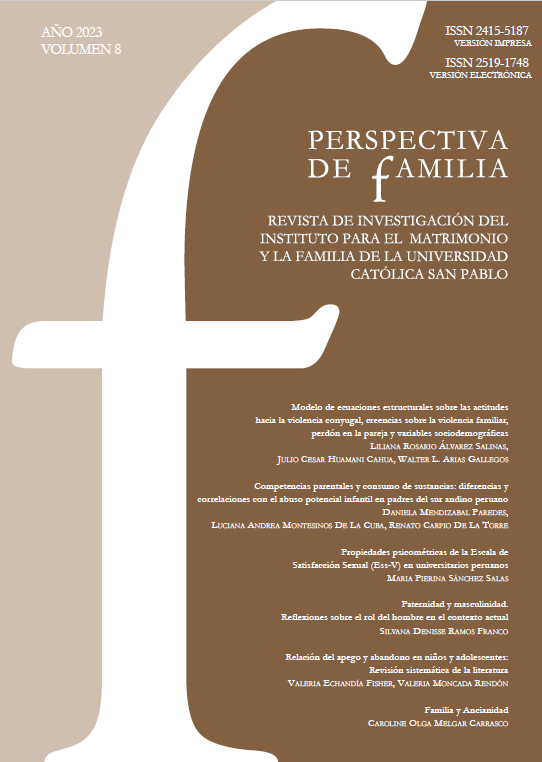
Fatherhood and manhood: Reflections on men’s roles in the contemporary context
Article Sidebar
Main Article Content
Abstract
The role of women and the legitimate struggle to reclaim their place in society and the recognition of their rights have acquired unprecedented relevance in contem- porary times. What began as a noble cause throughout the twentieth century has gradually become blurred. In the name of women’s rights, a battle was initiated against men, who have come to be portrayed as the sole perpetrators of all the hardships and injustices committed against women. As a result, the contemporary image of men has been diminished, and their role in society as fathers, husbands, and the natural complement of women has been progressively displaced. This ne- gative perception of men has given rise to a crisis that primarily affects men and, as an inevitable consequence, women, marriage, the family, and society as a whole. The present study seeks to examine this phenomenon and to propose a path that promotes complementarity and transcends the rupture between men and women.
Article Details
Section

This work is licensed under a Creative Commons Attribution-NonCommercial-NoDerivatives 4.0 International License.
How to Cite
References
Alvira, R. (2010). El lugar al que se vuelve: Reflexiones sobre la familia. Astrolabio.
Amato, P. (2005). The impact of family formation change on the cognitive, social,
and emotional well-being of the next generation. The Future of Children,
15(2), 75-96. https://doi.org/10.1353/foc.2005.0012
Anatrella, T. (2008). La diferencia prohibida. Sexualidad, educación y violencia: La herencia de mayo de 1968. Encuentro.
Anatrella, T. (2010) Antropología y defensa de la vida y de la familia, en la obra co- lectiva: La política al servicio del bien común. CEU Ediciones
Aparisi-Miralles, A. (2012). Modelos de relación sexo-género: De la “ideología de gé- nero” al modelo de la complementariedad varón-mujer. Díkaion, 21(2), 357- 384. https://dikaion.unisabana.edu.co/index.php/dikaion/article/view/2896/3064
Bernal, A. (Ed.). (2005). La familia como ámbito educativo. Ediciones Rialp.
Bernabé, P. (2005, 19 de diciembre). Esther Vilar: después de “El varón domado”. La
Nación.
Calvo, M. (2011). La masculinidad robada. Varones en crisis: El necesario encuen- tro con la masculinidad [Edición Kindle]. Almuzara. https://www.amazon. com/-/es/Mar%C3%ADa-Calvo-Charro-ebook/dp/B00EPD4PW2
Calvo, M. (2014). Padres destronados: La importancia de la paternidad [Edición Kindle]. Toromítico. https://www.amazon.com/-/es/Mar%C3%ADa-Cal-vo-ebook/dp/B00IYPY8EW/ref=tmm_kin_swatch_0?_encoding=UTF8&qi- d=&sr=
Cánovas Leonhardt, P., & Sahuquillo Mateo, P. M. (2010). Educación y diversi- dad familiar: aproximación al caso de la monoparentalidad. Educatio Siglo XXI, 28(1), 109–126. https://revistas.um.es/educatio/article/view/109751
Drexler, P & Gross, L (2005). Raising boys whitout men: How Maverick Moms are creating the next generation of exceptional men. Rodale Books
Guardini, R. (2015). El comienzo de todas las cosas: Meditaciones sobre Génesis, ca- pítulos 1-3 [Edición Kindle]. Desclée de Brouwer. (Trabajo original publicado en 1987). https://a.co/d/5Di5ZDX
Flaquer, L. (2012). La estrella menguante del padre. Ariel.
Hervada, J. (2007). Diálogos sobre el amor y el matrimonio. EUNSA/Astrolabio. Juan Pablo II. (1980, 2 de abril). Audiencia general. https://www.vatican.va/con-
tent/john-paul-ii/es/audiences/1980/documents/hf_jp-ii_aud_19800402.
Html
La Biblia. (2005). Edición San Pablo.
Instituto Nacional de Estadística. (2011). Estadística de nulidades, separaciones y divorcios. Año 2015. INE. https://www.ine.es/prensa/np990.pdf
López Moratalla, N. (2009). Cerebro de mujer y Cerebro de varón. Ediciones Rialp.
Meeker, M. (2008). Padres fuertes, hijas felices: 10 secretos que todo padre debería conocer [Edición Kindle]. Ciudadela Libros. https://www.amazon.com/-/es/ Meg-Meeker-ebook/dp/B007Z2AK0Q/ref=tmm_kin_swatch_0?_encodin- g=UTF8&qid=&sr=
Organización de las Naciones Unidas [ONU]. (2011). Declaración Universal de Derechos Humanos. https://www.ohchr.org/sites/default/files/UDHR/Docu- ments/UDHR_Translations/spn.pdf
Organización de las Naciones Unidas para la Educación, Ciencia y Cultura [UNES- CO]. (2011). Women in science. https://unesdoc.unesco.org/ark:/48223/pf000 0217092
Organización de las Naciones Unidas [ONU]. (1948, 10 de diciembre). Declaración Universal de Derechos Humanos. https://www.ohchr.org/sites/default/files/ UDHR/Documents/UDHR_Translations/spn.pdf