Child labor a silent practice
Article Sidebar
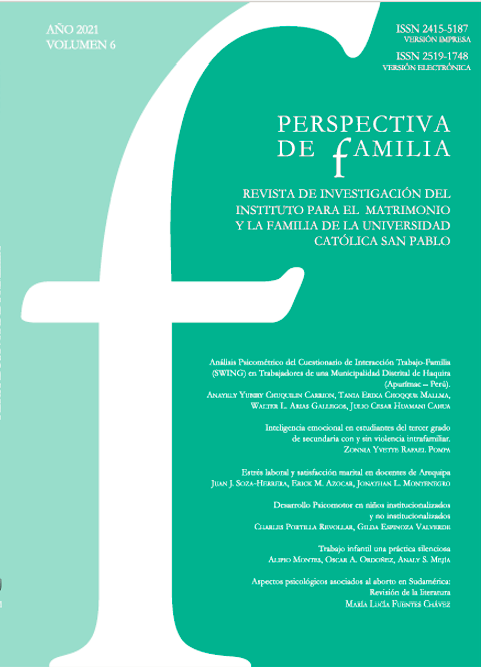
Main Article Content
Abstract
This article analyzed the subjective and socio-cultural repercussions of child la-bor and the influence of the application of the APTI-GAR methodology (Learning about Child Labor with Reflective Learning Groups by Giselle Silva Panez) on pa-rents who send their children to work. This group work model fosters the promotion of reflective thinking and learning. The sample consisted of 51 fathers and mothers of families whose children are involved in child labor and belong to Telefónica’s Foundation PRONIÑO Program from the Paucarpata district in Arequipa Province of Arequipa Region, and from Puquina district in General Sánchez Cerro Province of Moquegua Region. To evaluate the reflective processes in the decision-making of parents, three questionnaires were applied: Learning and reflective decisions (questionnaire for parents), My life as a working child (questionnaire for children) and Working Children (questionnaire for teachers). The selected parents partici-pated in 7 APTI-GAR sessions. As a result of the application of the APTI-GAR pro-gram, 39.2% of working children stopped working. It is concluded that through the application of the APTI-GAR Methodology, the participants learn to evaluate the dangers to which their children are exposed in child labor and through a reflective process, they value the importance of making decisions in a conscious way consi-dering past experiences, the role of father and mother, as well as the importance of a vision of the future.
Article Details
Section

This work is licensed under a Creative Commons Attribution-NonCommercial-NoDerivatives 4.0 International License.
How to Cite
References
Basu, K., y Hoang Van, P. (2009). The Economics of Child Labour. The American Economic Review,88(3), 412-427. https://www.jstor.org/stable/116842
Cavagnoud, R. (2016). Pobreza Familiar, trabajo adolescente y abandono escolar. Mirada sobre una relación compleja a partir del caso de Lima (Perú). México: Instituto de Investigaciones Jurídicas.
Del Río, M. F., y Cumsille, P. (2008). ¿Necesidad económica o preferencias cultura-les? La justificación parental del trabajo infantil en Chile. Psykhe, 17(2), 41-52. doi: 10.4067/S0718-22282008000200004
Díaz, L. (1998). Psicología del Trabajo y las Organizaciones. 37, 1–200. https:// ldiazvi.webs.ull.es/pstro.pdf
Díaz, R, y Benítez, R. (2017). El trabajo infantil: Revisión de las investigaciones desarrolladas en América Latina (Tesis de Maestría, Universidad de la Salle, Bogotá). Recuperado de https://ciencia.lasalle.edu.co/cgi/viewcontent.cgi?article=1121&context=maest_gestion_desarrollo
Fondo de Naciones Unidas para la Infancia (UNICEF). (2005). La infancia es mu-cho más que la época que transcurre antes de que la persona sea considerada un adulto. Recuperado de https://amnistiacatalunya.org/edu/2/nin/inf-unicef html
Gamero, C., y Lassibille, G. (2012). Escolarización, trabajo infantil y satisfacción laboral: Evidencia para la Etiopia, Revista de Economía Aplicada, XX(58), 95-118. Recuperado de https://www.redalyc.org/pdf/969/96924442004.pdf
Hernández, R., Fernández, C., y Baptista, P. (2014). Metodología de la Investigación
(6a ed.). México: Mc Graw Hill.
Instituto Nacional de Estadística e Informática (INEI). (2017). Perú: Características sociodemográficas de niños, niñas y adolescentes que trabajan, 2015. Recuperado de https://www.inei.gob.pe/media/MenuRecursivo/publicaciones_digitales/Est/Lib1426/libro.pdf
Lamiña, A. (2015). El Trabajo Infantil y su Influencia Negativa en el Desarrollo Integral de los Niños , Niñas y Adolescentes en el Barrio El Recreo , Cantón Quito,
Provincia de Pichincha , Durante el Año 2015. Recuperado de http://www.dspace.uce.edu.ec/bitstream/25000/8213/1/T-UCE-0013-Ab-398.pdf
Ledesma-Ayora, M. (2014). Análisis de la teoría de Vygotsky para la reconstrucción de la inteligencia social. Ecuador: Universidad Católica de Cuenca
Liebel, M. (2006). Los movimientos de los niños y niñas trabajadores. Un enfoque desde la sociología. Política y Sociedad, 43(1), 105-123.
Mitjáns, A. (2001). Trabajo infantil y subjetividad: una perspectiva necesaria. Estudios de Psicología, 6(2), 235-244.
Organización Internacional del Trabajo (OIT). (s.f.). Información de base sobre el trabajo infantil y la OIT. Recuperado de https://www.ilo.org/ipec/Campaignandadvocacy/Youthinaction/C182-Youth-orientated/C182Youth_Back-ground/lang--es/index.htm
Paz, J., y Piselli, C. (2011). Trabajo infantil y pobreza de los hogares en la Argentina.
Problemas del desarrollo, 116(42), 135-160.
SIM (2013) Sistema Internacional de Monitoreo Proniño de Fundación Telefónica.
Silva, G. (2012). Aprendiendo a pensar sobre el trabajo infantil APTI. Recuperado de http://mimp.gob.pe/files/direcciones/dgnna/congreso/expo_Que_es_el_ APTI.pdf
UNICEF. (2015). UNICEF. Definición de la infancia. Amnistia Internacional Catalunya. http://amnistiacatalunya.org/edu/2/nin/inf-unicef.html
Villena, J. A. (2011). Estrategia nacional para la prevención y erradicación del trabajo infantil en el Perú. Ministerio de Trabajo. Recuperado de http://portal.andina.com.pe/EDPFiles/EDPWEBPAGE_Estrategia_Trabajo_Infantil.pdf
Vygotsky, L. (2009). El desarrollo de los procesos psicológicos superiores. Barcelona: Crítica