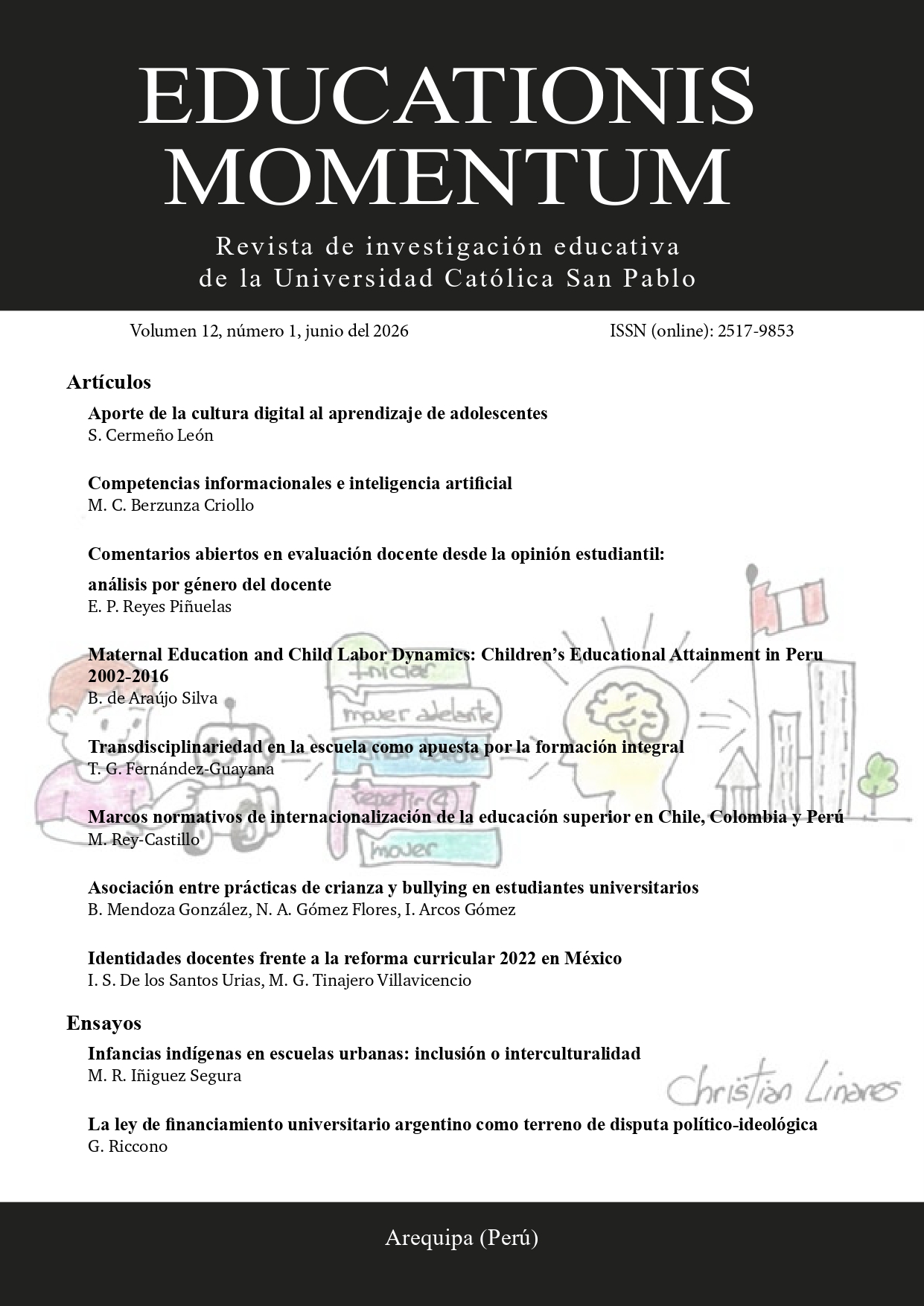
Aporte de la cultura digital al aprendizaje de adolescentes de quince años en el Perú
DOI:
https://doi.org/10.36901/em.v12i1.1889Palabras clave:
educación, cultura digital, Programa para la Evaluación Internacional de Alumnos (PISA), tecnologías de información y comunicación (TIC), capital humano, brecha digital, competencia matemática, PerúResumen
Contexto: la incorporación de las tecnologías de la información y comunicación (TIC) en la educación ha generado expectativas, pero buena parte de la evidencia previa aproxima su rol mediante el acceso a dispositivos o recursos escolares, lo que limita la comprensión de su vínculo con el aprendizaje. Objetivo: esta investigación analiza la asociación entre la cultura digital, entendida como el entorno digital directo e indirecto que rodea al estudiante, y el desempeño en competencia matemática de estudiantes de quince años en el Perú. Metodología: el estudio, de carácter observacional, utiliza PISA 2018 como fuente principal, complementada con Enaho 2018 y Renamu 2018, y construye indicadores mediante Análisis de Componentes Principales (ACP) que distinguen cuatro dimensiones (estudiante, hogar, escuela y contexto) y separan componentes tangibles de acceso e intangibles de uso y habilidades, estimados con regresiones lineales del puntaje PISA y controles progresivos. Resultados: se muestran asociaciones positivas y estadísticamente significativas que se reducen bajo controles más exigentes, aunque los indicadores globales y, en particular, los componentes del hogar y del rol docente mantienen relaciones robustas. Conclusiones: se concluye que mejorar los aprendizajes mediante TIC exige atender, además del acceso, los componentes intangibles de uso y habilidades y la articulación entre escuela y hogar.
Descargas
Referencias
Alderete, M. V., & Formichella, M. M. (2016). Efecto de las TIC en el rendimiento educativo: el Programa Conectar Igualdad en la Argentina. Revista CEPAL, (119), 89-107. https://repositorio.cepal.org/bitstream/handle/11362/40404/1/RVE119_Formichella.pdf
Ames, P. (2014). Niños y adolescentes frente a las nuevas tecnologías: Acceso y uso de las tecnologías educativas en las escuelas peruanas. Revista de Investigación Educativa Peruana, 6(6), 145-172. https://doi.org/10.34236/rpie.v6i6.44
Arias Ortiz, E., Cristia, J. P., & Cueto, S. (2020). Aprender matemática en el siglo XXI: A sumar con tecnología. Banco Interamericano de Desarrollo. https://publications.iadb.org/es/aprender-matematica-en-el-siglo-xxi-a-sumar-contecnologia
Becker, G. S. (1993). Human Capital: A Theoretical and Empirical Analysis with Special Reference to Education (3.a ed.). National Bureau of Economic Research.
Beuermann, D., Cristia, J., Cueto, S., Malamud, O., & Cruz-Aguayo, Y. (2015). One Laptop per Child at Home: Short-Term Impacts from a Randomized Experiment in Peru. American Economic Journal: Applied Economics, 7(2), 53-80. https://www.aeaweb.org/articles/pdf/doi/10.1257/app.20130267
Blaug, M. (1970). An Introduction to the Economics of Education. Allen Lane The Penguin Press.
Bronfenbrenner, U. (1979). The Ecology of Human Development. Harvard University Press.
Buckingham, D. (2007). Beyond Technology: Children’s Learning in the Age of Digital Culture. Polity Press.
Cristia, J. P., Ibarrarán, P., Cueto, S., Santiago, A., & Severín, E. (marzo del 2012). Technology and Child Development: Evidence from the One Laptop Per Child Program. IDB Working Paper Series, (304). https://publications.iadb.org/publications/english/document/Technology-and-ChildDevelopment-Evidence-from-the-One-Laptop-per-Child-Program.pdf
Cueto, S., Balarin, M., Saavedra, M., & Sugimaru, C. (2023). Ed-Tech in the Global South: Research gaps and opportunities. Occasional Paper Series 91 Southern Voice. https://southernvoice.org/ed-tech-in-the-global-south-research-gaps-andopportunities/
Cueto, S., Felipe, C., & León, J. (2018). Digital Access, Use and Skills Across Four Countries: Construction of Scales and Preliminary Results from the Young Lives Round 5 Survey. Young Lives. https://www.younglives.org.uk/sites/www.younglives.org.uk/files/YL-TN46.pdf
Cueto, S. (2007). Las evaluaciones nacionales e internacionales de rendimiento escolar en el Perú: balance y perspectivas. En Investigación, políticas y desarrollo en el Perú, 405-455. GRADE. http://www.grade.org.pe/upload/publicaciones/archivo/download/pubs/InvPolitDesarr10.pdf
Davis, F. (1989). Perceived Usefulness, Perceived Ease of Use, and User Acceptance of Information Technology. MIS Quarterly, 13(3), 319-340. https://doi.org/10.2307/249008
D. S. N.º 033-2002-PCM. Aprueban Reglamento del Registro Nacional de Municipalidades (Renamu) y el Directorio Nacional de Municipalidades de Centro Poblado Menor (Dinamucep). Diario Oficial El Peruano (2012). https://www.inei.gob.pe/media/archivos/DS_033_2002_PCM.pdf
Esteves, J. M., & Bohorquez, V. W. (2007, mayo). Analyzing the development of municipal e-Government in Peruvian cities. En Proceedings of the 9th International Conference on Social Implications of Computers in Developing Countries. São Paulo. https://citeseerx.ist.psu.edu/viewdoc/download?doi=10.1.1.92.1719&rep=rep1&type=pdf
Gere, C. (2008). Digital Culture (2.a ed.). Reaktion Books.
Heckman, J. J. (1999). Policies to Foster Human Capital. NBER Working Paper Series, (7288). https://www.nber.org/system/files/working_papers/w7288/w7288.pdf
Hébert, C., Thumlert, K., & Jenson, J. (2020). #Digital parents: Intergenerational learning through a digital literacy workshop. Journal of Research on Technology in Education. https://doi.org/10.1080/15391523.2020.1809034
Hopkins, Á. (2014). Internet en las escuelas: efecto sobre el rendimiento educativo en el Perú, 2007-2011. Diálogo Regional sobre Sociedad de la Información. http://hdl.handle.net/10625/55608
Instituto Nacional de Estadística e Informática (2018). Encuesta Nacional de Hogares (Enaho) 2018. http://iinei.inei.gob.pe/microdatos/
Instituto Nacional de Estadística e Informática (2018). Registro Nacional de Municipalidades (Renamu) 2018. http://iinei.inei.gob.pe/microdatos/
León, J., & Sugimaru, C. (2022). El uso de las tecnologías para la generación de aprendizajes: desafíos para la formación inicial y en servicio del profesorado. En M. Balarín, S. Cueto & R. Fort (Eds.), El Perú pendiente: ensayos para un desarrollo con bienestar (pp. 47-67). Grupo de Análisis para el Desarrollo (GRADE). https://www.grade.org.pe/publicaciones/el-uso-de-las-tecnologias-para-lageneracion-de-aprendizajes-desafios-para-la-formacion-inicial-y-en-servicio-delprofesorado/
Livingstone, S., Blum-Ross, A., Pavlick, J., & Ólafsson, K. (2018). In the digital home, how do parents support their children and who supports them? Parenting for a Digital Future: Survey Report 1. London School of Economics Department of Media and Communication. https://www.lse.ac.uk/media-andcommunications/assets/documents/research/preparing-for-a-digital-future/P4DFSurvey-Report-1-In-the-digital-home.pdf
Malamud, O., Cueto, S., Cristia, J., & Beuermann, D. W. (2018). Do children benefit from Internet access? Experimental evidence from Peru. NBER Working Paper Series, (25312). https://www.nber.org/system/files/working_papers/w25312/w25312.pdf
Mincer, J. (1981). Human Capital and Economic Growth. NBER Working Paper Series, (803). https://www.nber.org/system/files/working_papers/w0803/w0803.pdf
Ministerio de Educación (2021). Encuesta Nacional de Convivencia Escolar y Violencia en la Escuela: resultados principales. https://repositorio.minedu.gob.pe/handle/20.500.12799/7778
Mo, D., Swinnen, J., Linxiu Zhang, H. Y., Qu, Q., Boswell, M., & Rozelle, S. (2013). Can One-to-One Computing Narrow the Digital Divide and the Educational Gap in China? The Case of Beijing Migrant Schools. World Development, 46, 14-29. https://doi.org/10.1016/j.worlddev.2012.12.019
Muñoz, R. E., & Ortega, J. A. (2015). ¿Tienen la banda ancha y las TIC un impacto positivo sobre el rendimiento escolar? Evidencia para Chile. El Trimestre Económico, 82(325), 53-87. http://www.scielo.org.mx/pdf/ete/v82n325/2448-718X-ete-82-325-00053.pdf
Naik, G., Chitre, C., Bhalla, M., & Rajan, J. (2020). Impact of use of technology on student learning outcomes: Evidence from a large-scale experiment in India. World Development, (127). https://doi.org/10.1016/j.worlddev.2019.104736
Negroponte, N. (1995). Being Digital. Hodder and Stoughton.
Nikken, P., & Schols, M. (2015). How and Why Parents Guide the Media Use of Young Children. J Child Fam Stud, 24, 3423-3435. https://doi.org/10.1007/s10826-015-0144-4
Organización para la Cooperación y el Desarrollo Económicos (OCDE) (2000). Measuring Student Knowledge and Skills, The Pisa 2000 Assessment of Reading, Mathematical and Scientific Literacy. https://doi.org/10.1787/19963777
Organización para la Cooperación y el Desarrollo Económicos (OCDE) (2019). Chapter 4: Sample Design. En PISA 2018 Technical Report. https://www.oecd.org/pisa/data/pisa2018technicalreport/PISA2018%20TecReportCh-04-Sample-Design.pdf
Organización para la Cooperación y el Desarrollo Económicos (OCDE) (2019). PISA 2018 Results (Volume I): What students know and can do. https://doi.org/10.1787/5f07c754-en
Plataforma Nacional de Datos Abiertos (2021, marzo 8). Encuesta Nacional de Hogares (Enaho) 2019 - [Instituto Nacional de Estadística e Informática - INEI]. https://www.datosabiertos.gob.pe/dataset/encuesta-nacional-dehogares-enaho-2019-instituto-nacional-de-estad%C3%ADstica-einform%C3%A1tica-inei
Renteria, R., Rojas, H., Aguirre, W., Arévalo, Z., & Ibarra, M. (2019). Challenges in the Implementation of E-government for Public Institutions in Peru. En Proceedings of the 10th International Conference on E-Education, E-Business, E-Management and E-Learning, 347-351. https://doi.org/10.1145/3306500.3306572
Santana, M. (2009). A preliminary assessment of the development of e-Government in a local government in Peru. Journal of Asia-Pacific Studies, Waseda University, (12), 75-89. https://www.academia.edu/21920988/A_Preliminary_Assessment_of_the_Development_of_e-Government_in_a_Local_Government_in_Peru
Tarhini, A., Elyas, T., Akour, M. A., & Al-Salti, Z. (2016). Technology, Demographic Characteristics and E-Learning Acceptance: A Conceptual Model Based on Extended Technology Acceptance Model. Higher Education Studies, 6, 72-89. https://doi.org/10.5539/hes.v6n3p72
Teles, A., & Joia, L. (2011). Assessment of digital inclusion via the actor-network theory: The case of the Brazilian municipality of Piraí. Telematics and Informatics, 28(3), 191-203. https://doi.org/10.1016/j.tele.2010.09.003
Valcke, M., Bonte, S., De Wever, B., & Rots, I. (2010). Internet parenting styles and the impact on Internet use of primary school children. Computers & Education, 55(2), 454-464. https://doi.org/10.1016/j.compedu.2010.02.009
Valdivia, M. (2002). Acerca de la magnitud de la inequidad en salud en el Perú. Documento de Trabajo 37. http://www.grade.org.pe/wpcontent/uploads/ddt37.pdf
Venkatesh, A. (2008). Digital home technologies and transformation of households. Information Systems Frontiers, 10(4), 391-395. https://doi.org/10.1007/s10796-008-9097-0
Williams, R. (1961). The Long Revolution. Broadview Press.
Yang, Y. (2017). Towards a New Digital Era: Observing Local E-Government Services Adoption in a Chinese Municipality. Future Internet, 9(3). https://doi.org/10.3390/fi9030053
Zhang, H., & Zhu, C. (2016). A Study of Digital Media Literacy of the 5th and 6th Grade Primary Students in Beijing. The Asia-Pacific Education Researcher. https://www.researchgate.net/publication/296469050_A_Study_of_Digital_Media_Literacy_of_the_5th_and_6th_Grade_Primary_Students_in_Beijing
Zhang, C. (2010). Technology acceptance in learning settings from a student perspective: a theoretical framework. Proceedings of the 2010 ACM Conference on Information Technology Education, 37-41. https://doi.org/10.1145/1867651.1867663
Descargas
Publicado
Número
Sección
Licencia
Derechos de autor 2026 Sandra CERMEÑO LEÓN

Esta obra está bajo una licencia internacional Creative Commons Atribución 4.0.