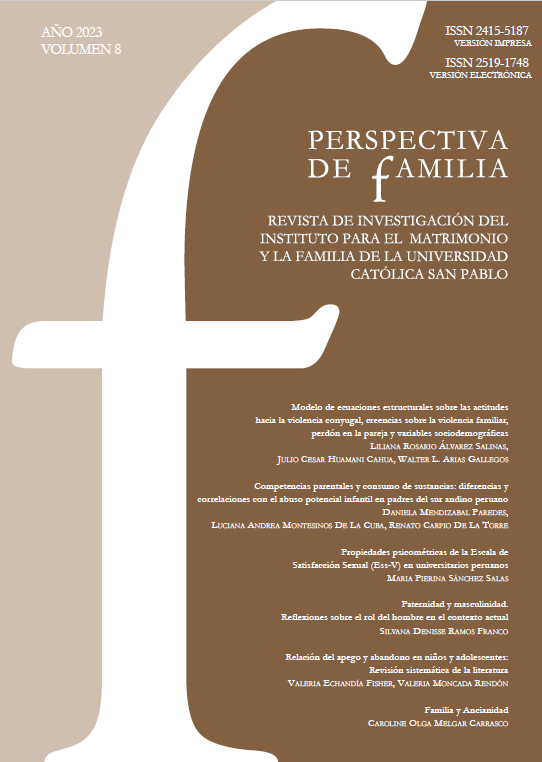
Structural equation model of the attitudes toward conjugal violence scale, beliefs about family violence, forgiveness in couples and sociodemographic variables
Article Sidebar
Main Article Content
Abstract
This study examines the relationships among attitudes toward conjugal violence, beliefs that perpetuate domestic violence, forgiveness within the couple, and selec-ted sociodemographic variables using a structural equation modeling approach. A sample of 1,977 women from the city of Arequipa, Peru, was assessed using the Attitudes Toward Conjugal Violence Scale, the Scale for Measuring Beliefs that Perpetuate Domestic Violence, and the Forgiveness in Couple Relationships Scale, all of which demonstrated adequate levels of validity and reliability. The results indicate that the proposed theoretical model explains up to 11% of the variance in attitudes toward conjugal violence. Specifically, beliefs that perpetuate domestic violence positively predict attitudes toward conjugal violence, while forgiveness within the couple reinforces beliefs that sustain domestic violence. Additionally, age, educational attainment, number of children, and monthly income were found to be significantly associated with both violence-related attitudes and forgiveness within the couple.
Article Details
Section

This work is licensed under a Creative Commons Attribution-NonCommercial-NoDerivatives 4.0 International License.
How to Cite
References
Aalgaard, R. A., Shelton, T. G., & Englar-Carlson, M. (2016). The role of forgiveness in the relationship between childhood sexual abuse and adult marital satisfaction. Journal of Family Violence, 31, 233-242. https://doi.org/10.1007/s10896-015-9762-x
Aiquipa, J. J. (2015). Dependencia emocional en mujeres víctimas de violencia de pareja. Revista de Psicología (PUCP), 33(2), 411-437.
Andrades, M. V., Rivera, C., & Reyes, M. (2021). Estudio comparativo de la satisfacción marital en hombres y mujeres de la ciudad de Arequipa. Revista de Psicología (UCSP), 11(1), 11-25. https://doi.org/10.36901/psicologia.v11i1.1218
Apaza, B., & Roberts, R. (2006). Celos y violencia en la pareja: un estudio en universitarios. Revista de Psicología (UNSA), 3(1), 59-68.
Araya, C. (2003). Creencias que perpetúan la violencia intrafamiliar: un estudio descriptivo en la ciudad de Santiago. Tesis de Licenciatura. Universidad de Chile.
Arenas, A., & Cárdenas, C. (2009). Infidelidad y violencia en la relación de pareja. Revista de Psicología (PUCP), 27(1), 143-162.
Arias, W. L., Huamani, J. C., & Ceballos, K. D. (2017). Transmisión transgeneracional de la violencia intrafamiliar: un estudio en la ciudad de Arequipa. Revista de Psicología (UCSP), 7(1), 39-51.
Arias, W. L., Rivera, R., & Ceballos, K. D. (2021). Celos y violencia en parejas de la ciudad de Arequipa. Revista de Investigación en Psicología, 24(1), 47-64. https://doi.org/10.15381/rinvp.v24i1.20573
Arnoso, A., Arnoso, M., & Pérez-Sales, P. (2017). Violencia de pareja y sexismo: un estudio comparativo entre hombres y mujeres. Anuario de Psicología Jurídica, 27, 43-51. https://doi.org/10.1016/j.apj.2017.02.001
Ato, M., López, J. J., & Benavente, A. (2013). Un sistema de clasificación de los diseños de investigación en psicología. Anales de Psicología, 29(3), 1038-1059. https://doi.org/10.6018/analesps.29.3.178511
Azabache, M., & Rojas, M. (2005). Locus de control y violencia doméstica en mujeres de una zona urbano marginal de Trujillo. Revista de Psicología (UCV), 7(1), 33-46.
Bagnulo, A., Maganto, C., & Cruz, M. S. (2009). El perdón como herramienta terapéutica en las relaciones de pareja. Revista de Psicología (UP), 1(1), 7-22.
Ballester, R., Gil-Llario, M. D., & Giménez, C. (2009). El perdón en las relaciones de pareja: una aproximación teórica. Revista de Psicología (UP), 1(1), 23-38.